
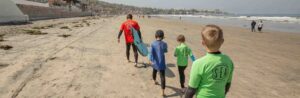
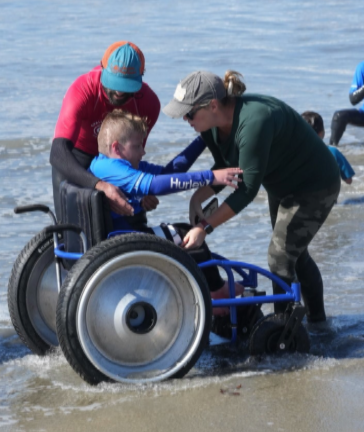
If you’ve landed here, you’ve probably already done the hard part. You decided that surfing belongs to your family too — no matter the stakes. We’re excited you stumbled upon this blog. Thank you for starting a surf journey with us and that’s the leap most people never take.
Now you need to know how it works, how it’s paid for, and how to get the wheels turning. We’ll walk you through it.
We’re Surf Education Academy, a City of San Diego–permitted surf school running adaptive lessons at La Jolla Shores. Our founder, Sean Brody, was Head Coach for Team USA Adaptive Surfing — so when we say we adapt the lesson to the surfer (and not the other way around), that’s not marketing. That’s the whole reason we exist.
The Quick Version
- Where: La Jolla Shores — 2132 Avenida De La Playa, La Jolla, CA 92037
- Who it’s for: Surfers of all ages and abilities — physical, sensory, cognitive. Every program is individualized.
- How families pay: Regional Center funding, the Self-Determination Program (SDP), or private pay.
- Pricing: $250 for a 1.5-hour session · $450 for a 3.5-hour session.
- First step: Submit an adaptive surfing interest form — link here.
- From inquiry to first session: Roughly 2–4 weeks for funded clients (sometimes faster, sometimes longer, depending on how the funding side moves). Private pay can start as soon as scheduling allows.
The Three Ways Families Pay for Adaptive Surf Lessons
Almost every adaptive family we work with falls into one of these three pathways. The pathway shapes the timeline, not the surfing.
1. Regional Center Funding
If your surfer is a client of the San Diego Regional Center (SDRC) — or any California Regional Center — adaptive recreation may be funded as part of their services. Your Service Coordinator is your point of contact for getting that authorization moving.
2. Self-Determination Program (SDP)
SDP is the alternative pathway where you — the family or surfer — direct the budget yourself, with the help of a Financial Management Service (FMS). As long as adaptive surf lessons align with the goals in the surfer’s Individual Program Plan (IPP), SDP families can use their budget with non-traditional providers like us. The FMS handles the payment side; you handle the decisions.
3. Private Pay
No Regional Center, no SDP, no waiting. You book, we schedule, you surf.
If you’re not sure which pathway applies to your family, just say so in the interest form. We’re used to walking families through this.
How the Process Actually Works — Step by Step
Here’s the whole thing, start to finish. Read it once, and the rest of this post will make sense.
Step 1 — Submit the Adaptive Surfing Interest Form
Start here: Adaptive Surfing Interest Form.
You’ll tell us a little about the surfer (age, abilities, goals) and which funding pathway you’re working with — Regional Center, SDP, or private pay.
Step 2 — We Send You the Intake Form
Once we’ve reviewed your interest form, we follow up with a more detailed intake. This is where we get the full picture — medical considerations, comfort in the water, communication preferences, supports, sensory needs, what success looks like for your surfer.
The intake builds your surfer’s client profile, which is the backbone of everything we do. Every coach knows it. Every session references it. Every progress note adds to it.
Step 3 — Funding Pathway (this is where timelines vary)
If you’re private pay: Skip to Step 4. We’re ready when you are.
If you’re using Regional Center or SDP funding: This is the part that takes time, and it’s the part most schools don’t explain well. Here’s what’s actually happening:
- For Regional Center families, your Service Coordinator has to authorize the service. That involves paperwork, sometimes additional review, and routing the authorization to us.
- For SDP families, your FMS has to set us up in their system to receive payment, and the spending plan has to reflect the service.
- For both, we need a direct line to the person handling the funding on your side — coordinator, FMS contact, whoever. Once we have that contact, we stay in communication with them so nothing falls through the cracks.
We can — and do — assist your coordinator with the process. We’ve done this enough to know what they need from us and when. But we can only help if we know who they are, so please share that contact in the intake.
Realistic timeline: 2 to 4 weeks for funded clients is typical. Sometimes it moves faster. Sometimes a particular case takes longer. We’ll keep you updated either way.
Step 4 — Schedule Sessions
Once funding is in place (or immediately, for private pay), we build a session schedule that works for your surfer’s calendar — school, therapies, energy levels, the whole picture. Adaptive surfing isn’t a generic booking slot; it’s a rhythm that fits your life.
Step 5 — Surf, Track, Adjust
Sessions happen at La Jolla Shores. We record session notes for each surfer — what we worked on, what’s progressing, what we want to try next time. That goes into the client profile.
Progress gets shared with you so you can see what’s actually changing. Families using Regional Center or SDP funding often share these notes with their team — Service Coordinators, FMS, IEP teams, therapists — because real documentation matters when funding is involved.
This is what we mean by individualized: it’s not a class, it’s a relationship. Same coach when possible. Same plan, refined over time.
How S.E.A. Helps With Regional Center and SDP Funding
We can’t issue the authorization — only your Regional Center or FMS can do that — but we can make the rest of it smoother. Specifically:
- We respond promptly to coordinators. We know what they need. We send it.
- We keep a designated point of contact on our side for funding-related communication, so there’s never a question of “who do I email at the surf school.”
- We document sessions in a way that’s useful for IPP review. Progress notes, attendance, observed gains — written so they’re meaningful, not just box-checking.
- We help families understand what’s possible. If you’re not sure whether your IPP covers adaptive recreation, ask us. We can’t speak for your Regional Center, but we can tell you what we’ve seen work for other families.
Families using regional funding deserve a process that’s smooth, efficient, and effective. That’s why this whole pathway exists — and it’s why we built ours around it.
What an Adaptive Session Actually Looks Like
No two adaptive sessions look the same, and that’s the point.
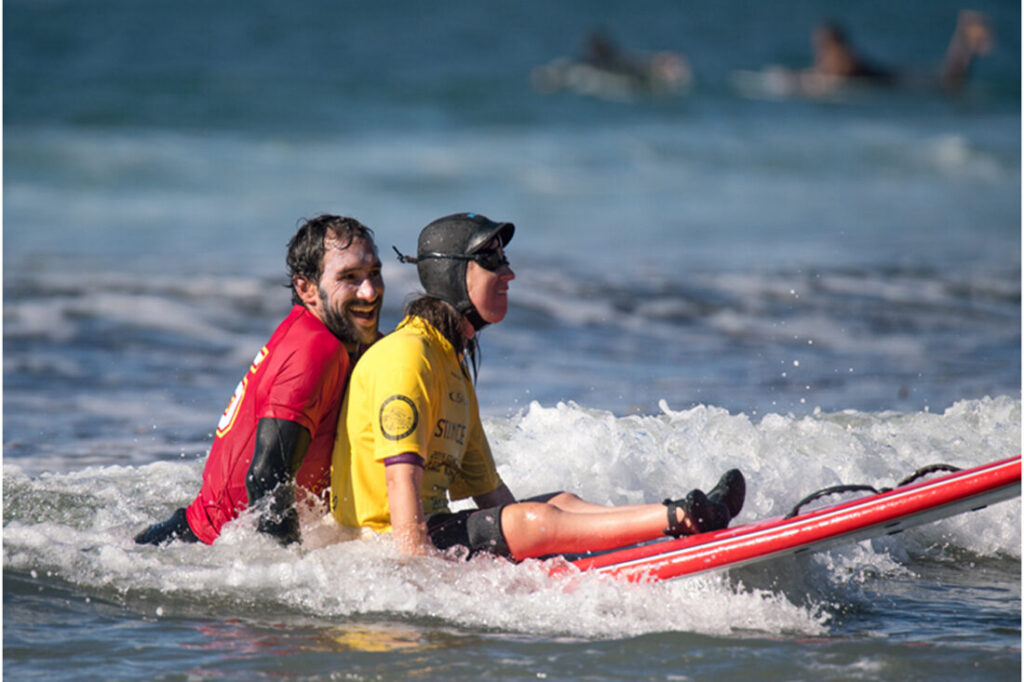
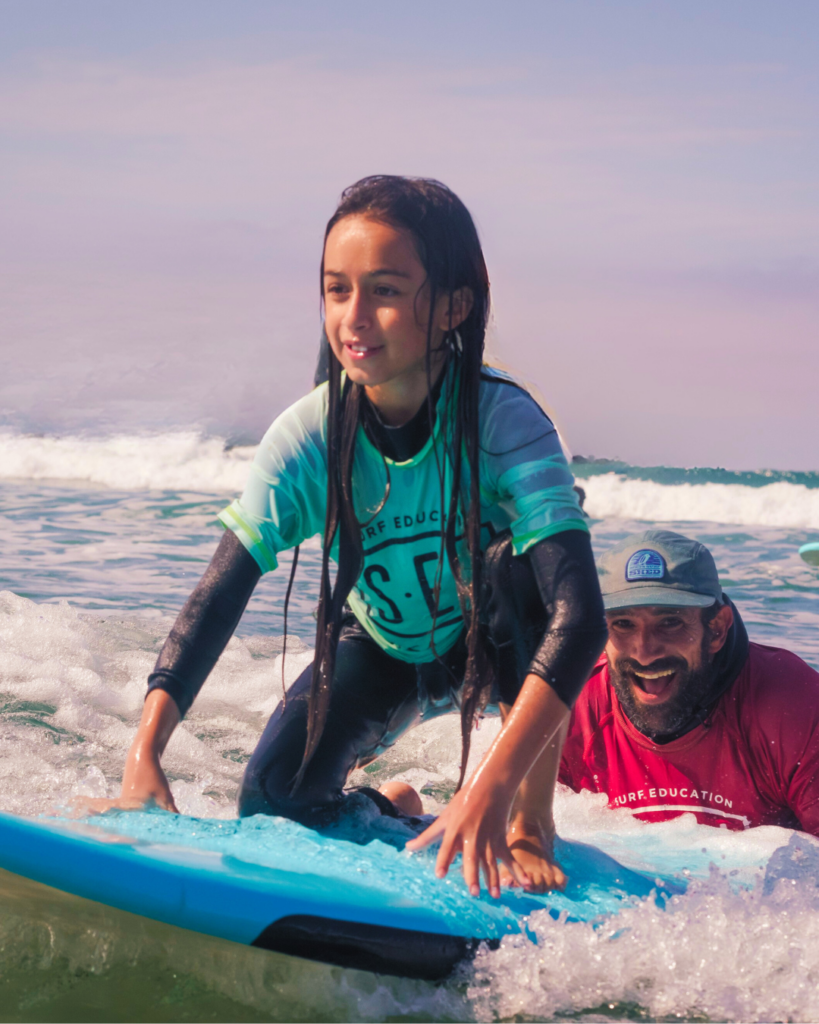
On the day, we meet you at La Jolla Shores. We handle the gear and there’s beach access parking. Then we go at your surfer’s pace. For some, day one is catching whitewater lying down and grinning the whole way. Some just ease into learning the ocean and how ti moves, the moving of the water, sitting on the board, and getting more comfortable being out in the ocean. Our instructors work diligently working with the surfers and the care takers to better know how to connect and build the confidence and ocean awareness within.
For others, it’s just getting out in the water and allowing the surf to do the work. All count. ALL are surfing.
Oh — one thing parents and partners always ask: yes, you can be on the beach the whole time. A lot of families want to be right there, and we want that too. Any and all help and notes with families and staff allows our team to make the best connections out in the water.
Adaptive Surf Lesson Pricing
Because these sessions are highly individualized and staffed differently than our traditional group surf camps and lessons, pricing reflects the additional support, resources, and program structure provided.
| Session Type | Length | Price |
|---|---|---|
| Adaptive Surf Session | 1.5 hours | $250 |
| Extended Adaptive Surf Session | 3.5 hours | $450 |
For Regional Center and SDP families, billing routes through your Service Coordinator or FMS once authorization is in place. For private pay families, we’ll confirm payment details when we schedule your sessions.
Ready to Get Started?
The first step is the interest form.
Tell us about your surfer, tell us how you plan to pay, and we’ll take it from there.
Submit Your Adaptive Surfing Interest Form →
If you have questions before you fill anything out, that’s fine too — email or call us at +1-858-269-5063.
We’d rather you feel ready than rushed.
Surf Education Academy · 2132 Avenida De La Playa, La Jolla, CA 92037 · +1-858-269-5063 ·
Adaptive surf lessons led by USA Surfing–recognized coaches. Reviewed by Sean Brody, former Head Coach, Team USA Adaptive Surfing.