
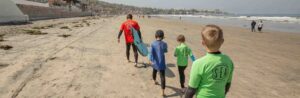
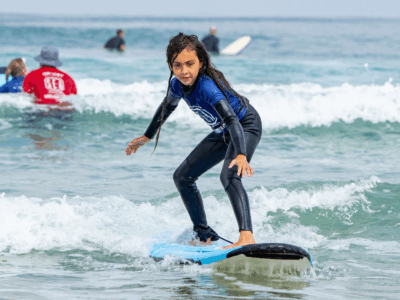
So you’re standing in your kitchen, phone in hand, trying to figure out where to book your kid’s first surf lesson in San Diego. You’ve got tabs open. You’ve got Pacific Beach. You’ve got La Jolla. And honestly? They kind of blur together when you’re new to this.
We get this question all the time — like, every week — so let’s just talk it through the way we’d talk it through if you walked up to our canopy at the Shores and asked us straight.
Here’s the short version: Pacific Beach is a fantastic beach. We mean that. The boardwalk, the energy, the tacos — it’s a vibe. But if the goal is your six-year-old standing up on a wave for the first time, or you finally crossing surfing off the bucket list at 48 without getting worked, La Jolla Shores is the better classroom. Not by a little. And it mostly comes down to one thing nobody tells you until you’re already out there: the water itself.
Let’s get into it.
Quick gut check: who’s this even for?
Before we nerd out on swell and sandbars, let’s name who actually benefits from picking the Shores over PB:
- Little kids. First-timers, groms, the 5-to-8 crowd who need calm water and an instructor standing right next to them.
- Nervous adults. You’d be shocked how many grown-ups quietly tell us “I’m actually kind of scared of the ocean.” We love you. The Shores is your spot.
- Older learners. Picking up surfing in your 50s or 60s? Absolutely doable — but you want soft sand under you, not reef.
- Families who want to all be in the water together without one kid getting hammered by a wave they weren’t ready for.
If that’s you, keep reading. If you’re an intermediate looking to get pitted on a punchy shortboard day — respectfully, this post isn’t for you, and we’d probably send you up to Blacks anyway.
The thing about Pacific Beach in summer (that the brochures skip)
Okay. Here’s the part that actually matters and almost nobody explains to beginners.
San Diego gets a lot of its summer surf from south swells — energy that travels up from storms way down in the Southern Hemisphere. Pacific Beach sits pretty exposed and open to that energy. PB is also notably tide-sensitive — meaning the wave can change personality fast as the tide moves, and on the wrong tide it’ll close out, which is surf-speak for the whole wave collapsing at once instead of peeling gently. A closeout is no fun for anyone, but for a first-timer it’s the difference between a confidence-building little roller and getting tumbled in the washing machine.
So picture a typical July afternoon at PB: a south swell’s running, the tide’s doing its thing, the lineup’s packed, and the waves are coming in steeper and breaking harder than a brand-new surfer can handle. That’s not a knock on PB — experienced surfers love that. But it’s a tricky place to learn, and an even trickier place to keep a nervous six-year-old feeling safe.
Oh — one thing worth saying out loud: PB also just gets crowded. Boardwalk crowds, lineup crowds, summer-tourist crowds. More bodies and more boards in the water is more to manage when you’re brand new. It adds up.
Why La Jolla Shores is built different (literally)
Now let’s walk over to the Shores. Couple of reasons this beach is the one surf schools — including us — keep coming back to.
It’s tuned for the gentle stuff. La Jolla Shores does its best work on west and northwest swells, and it’s way less tide-sensitive than PB. So the wave holds its shape across more of the day instead of flipping from “fun” to “closeout” the second the tide turns. Translation for parents: more makeable, stand-up-able waves, more of the time.
The sandbars hold the wave together. The Shores is famous for the sandbars that form along the beach and on either side of Scripps Pier — and those sandbars hold more swell before closing out than the beaches to the south. That’s the technical reason the waves here roll instead of dump. It’s a forgiving wave by design.
A south wind behaves itself here. Here’s a subtle one. A south wind that messes up the wave face at other San Diego spots tends to blow offshore or sideshore at the Shores — which actually cleans things up instead of wrecking them. The local geometry of the point and cove just works in a beginner’s favor.
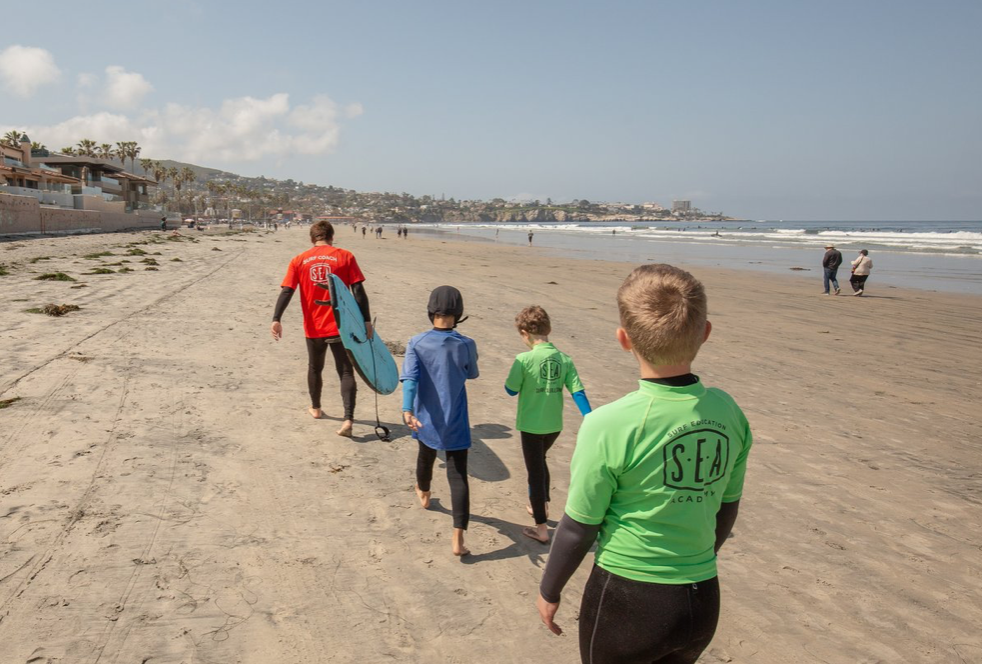
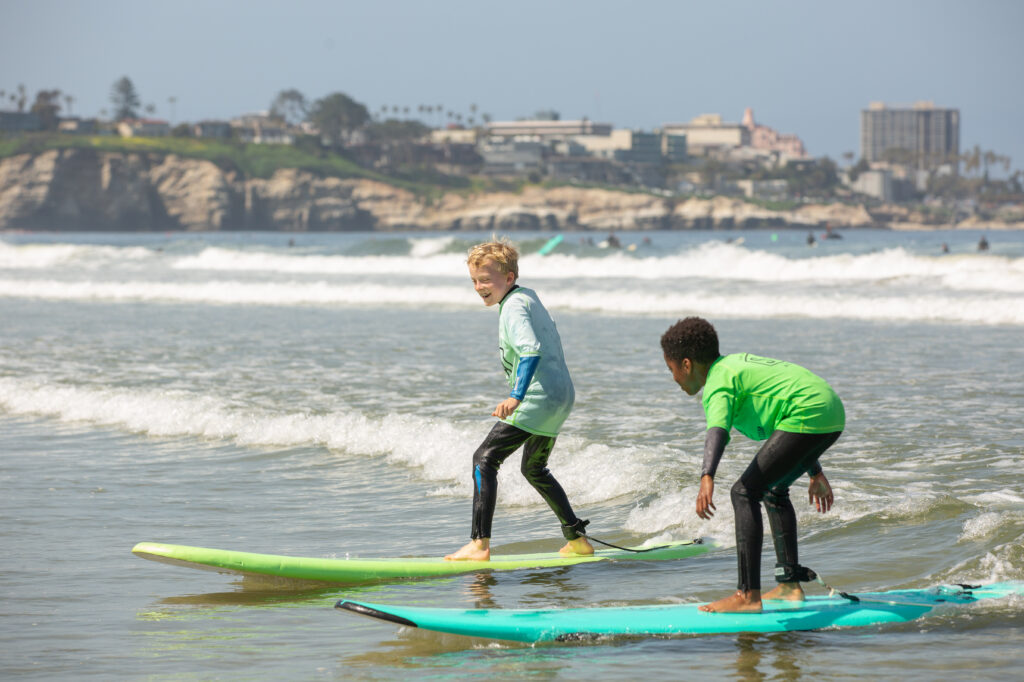
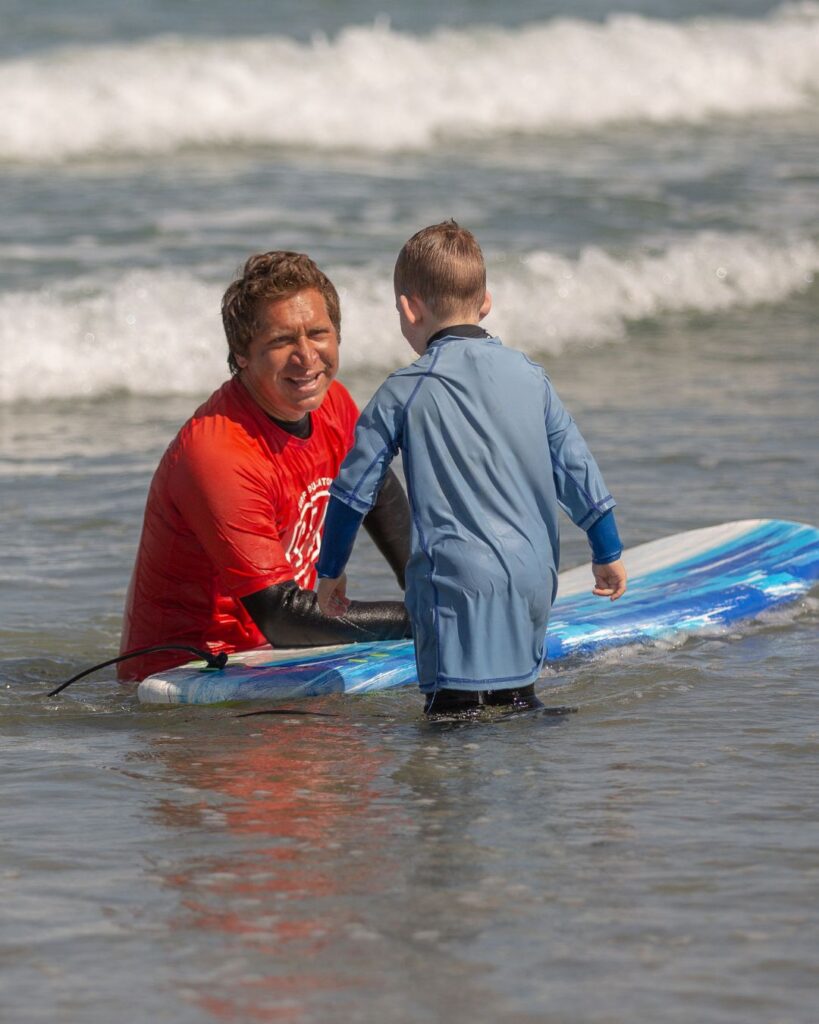
And then there’s the bottom. This is the big one. La Jolla Shores has a soft, sandy bottom — not the rock and reef you’ll find at a lot of San Diego’s other breaks. When a beginner falls (and everybody falls), they’re landing on sand. The beach also has a gentle, gradual slope, so you can wade out a long way and still touch. That’s huge for a kid. That’s huge for a scared adult. It means our instructors can literally stand right next to a student in chest-deep water and steady the board.
Add it up and you get a beach that USA Today has actually ranked among the best in the country for beginners. It’s not just us saying it.
Side by side: Shores vs PB for learning
| What matters to a beginner | La Jolla Shores | Pacific Beach |
|---|---|---|
| Bottom | Soft sand and soft waves | Sand, but harder/closeout-prone breaks nearby |
| Summer south swell exposure | More sheltered, orderly | More exposed, can get steep |
| Tide sensitivity | Sand bars allow a flexible array of breaks to spread out the crowd | Larger Beach but tide swings with exposed swells creates stronger rips. |
| Wave personality for beginners | Slow, rolling, forgiving (For the experienced surfers will go to Blacks Beach, wanting to catch the south swells in near La Jolla Shores.) | Punchier, faster on the wrong tide (Intermediate and Experienced surfers learning) |
| Instructor can stand beside you | Yes — gradual slope + sandbar, softer rip currents | Harder in steeper shorebreak and stronger rip currents |
| Crowds | Busy but has a designated surf zone | Boardwalk + lineup + tourist crowds |
| Lifeguards | Year-round | Year-round |
| Vibe | Mellow, family, marine-life | High-energy, nightlife-adjacent |
Neither beach is “bad.” But look down that left column. Every single row is the thing that decides whether a beginner has a great first day or a scary one.
“But isn’t the Shores crowded too?”
Fair. Yes — summer at the Shores gets busy. We’re not going to pretend otherwise. The difference is the Shores has a designated surfing area that keeps boards separated from the swimmers and the splash-around crowd, and the beginner zone near the lifeguard tower stays mellower while the more serious surfers drift north toward Scripps Pier. So even on a packed day, a good surf school can carve out a safe, organized little patch of ocean for a lesson. That’s a lot of what you’re paying us for, honestly — keeping your group spaced, supervised, and catching waves instead of dodging traffic.
More than a surf lesson — it’s a whole day at the Shores
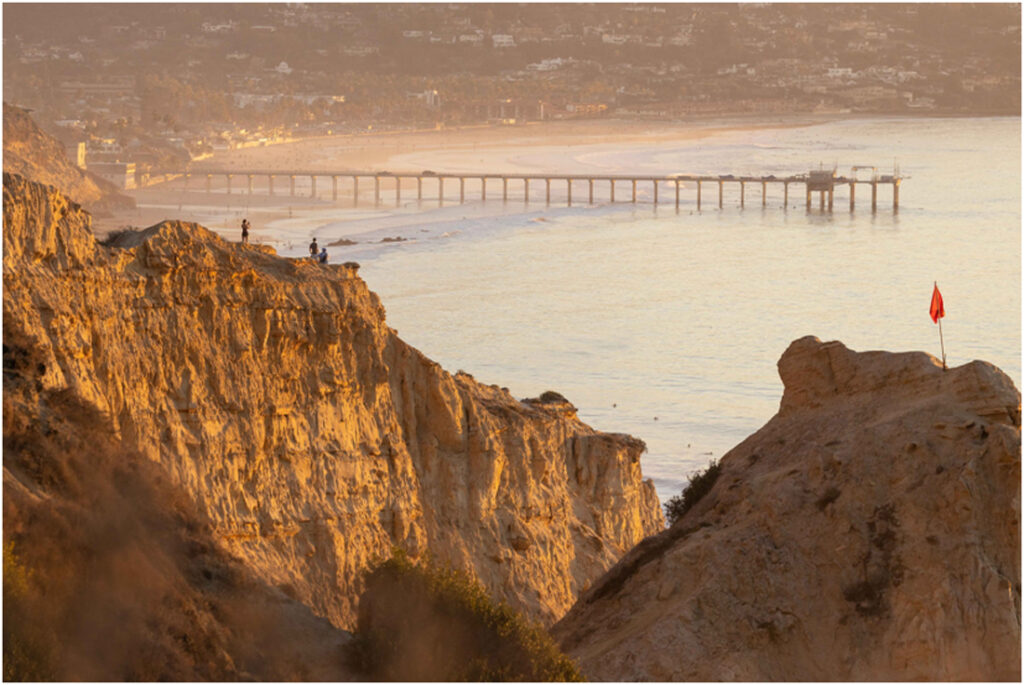
Here’s something PB just can’t match: at La Jolla Shores, the surf lesson is the start of the day, not the whole thing.
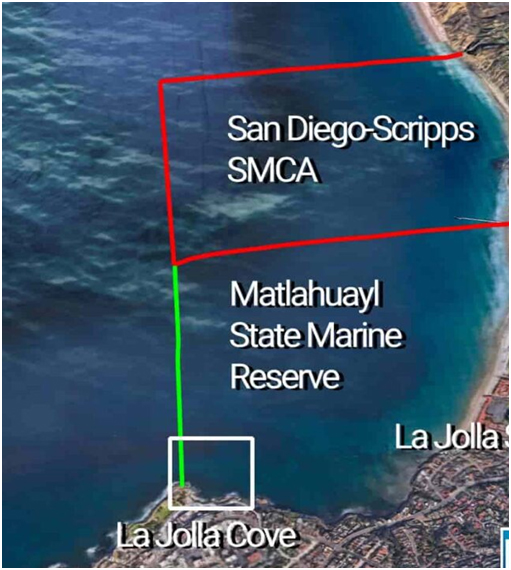
Walk a few minutes up the beach and you’re at La Jolla Cove — and suddenly your family’s got options. Kayaking. Stand-up paddleboarding. Snorkeling through the Matlahuayl State Marine Reserve, one of California’s protected marine areas, where the sea life is genuinely next-level. (Here’s the full rundown on the reserve and why it’s so special.) It’s the kind of spot where kids learn why we protect the ocean by actually being in it.
And the leopard sharks? Every summer they school up in the warm shallows right off the Shores. They’re completely harmless — no teeth to worry about, totally chill — and watching a kid spot their first one is honestly one of the best parts of the job. The eyes go wide every time.
Then there’s the timing trick most families miss: after your surf session, or on a low tide, the tide pooling is incredible. Little pockets of ocean left behind in the rocks, full of crabs, anemones, tiny fish — it’s a built-in treasure hunt, and it’s the kind of thing the whole family can do together, no skill or gear required. Surf in the morning, tide pool in the afternoon. That’s a full, free, screen-free day right there.
Want to stretch your legs? Torrey Pines State Natural Reserve is right up the road — cliffs, trails, and some of the best coastal hiking in San Diego, all a few minutes away.
Look — Pacific Beach is close by, and it’s got its boardwalk energy if that’s what you’re after. But La Jolla hits different. The cliffs, the cove, the marine reserve, the quieter landscape — it’s a calmer, more natural backdrop, and notably not the young-college-crowd party scene PB is known for. For a family day, or a first-timer who wants the ocean to feel welcoming instead of chaotic, that difference matters.
The part where we’re a little biased (and why it’s earned)
Quick honesty moment. We’re Surf Education Academy, we teach at La Jolla Shores, so of course we’re going to tell you the Shores is great. But here’s the stuff that actually backs it up:
We’re one of only a handful of surf schools permitted by the City of San Diego to legally run lessons and camps at La Jolla Shores. That permit isn’t a participation trophy — it means we got vetted, we’re legit, and we’re held to a standard. A lot of folks teaching on San Diego beaches aren’t permitted at all.
Our founder, Sean Brody, isn’t a random guy who rented some soft-tops. He’s the former Head Coach of the U.S. Adaptive Surfing Team and has worked alongside the International Surfing Association. When we say we know how to teach someone who’s nervous, who’s never done this, who needs a patient, safety-first approach — that comes from coaching at the absolute highest level of making the ocean accessible to everyone.
And the Shores itself does half the work for us. The sandy bottom, the gradual slope, the year-round lifeguards, the marine life that makes kids’ eyes go wide (yes, you’ll probably see leopard sharks in the summer — they’re harmless, and the kids lose their minds over it). It’s just a better place to fall in love with surfing.
And honestly? This is the part we’d want a friend to know.
And honestly? This is the part we’d want a friend to know.
There are only three surf schools permitted by the City of San Diego to legally teach at La Jolla Shores. Surf Education Academy is one of them. That’s it — three.
Everyone else you’ll find advertising lessons at the Shores? Not sanctioned. Not permitted. Not vetted by the city. And we’re not saying that to scare you — we’re saying it because it genuinely matters for your family’s safety and your wallet.
A permit means the city has checked that we carry proper insurance, that we meet safety and operating standards, and that we’re accountable to someone if something goes wrong. An unpermitted operator has skipped all of that. They can be cited or shut down mid-season, which means the lesson you prepaid for can vanish. There’s no oversight on their safety practices, their instructor training, or their insurance. If your kid gets hurt in the water with an unpermitted school, you may have nobody to turn to.
So here’s our honest heads-up: before you book anyone at La Jolla Shores — including us — ask the question. “Are you one of the three permitted surf schools?” A legit operator will answer in a heartbeat and be proud to. If they dodge it, get vague, or change the subject? That tells you everything you need to know. Walk away.
We’ll always answer it straight: yes, we’re permitted, we’re vetted, and we’re happy to show you. Your family deserves to know exactly who you’re handing the boards — and your kids — to.
So, where should your kid learn?
If you want the honest, no-spin answer: for a first-timer, a kid, a family, or a cautious adult, La Jolla Shores beats Pacific Beach for learning to surf — especially in summer, when PB’s exposure to south swells and quicker tide changes can serve up the kind of waves beginners aren’t ready for. The Shores gives you forgiving rollers, soft sand, a gentle slope, and instructors who can stay right at your side.
PB will always be there for the boardwalk day. But the first wave? Come do that with us at the Shores.
Ready to get your kid (or yourself) standing up this summer?
👉 Book a lesson at La Jolla Shores — private and small-group options for all ages and levels.
👉 Check out our 2026 Surf Camps — age-grouped, capped small, beginner-friendly, and held right on the sand at the Shores.
Got questions before you book? Call us at (858) 269-5063 — we’ll talk you through which option fits your kid, your family, or your own first wave. No pressure. We just love this stuff.
